
close
Choose Your Site
Global
Social Media
Author: Site Editor Publish Time: 2026-07-03 Origin: Site


Modern commercial and industrial facility design requires maximum natural light to boost productivity and reduce operational costs. Designers often face a difficult compromise between indoor brightness and overall building safety. Securing adequate illumination without introducing structural liabilities remains a major engineering challenge today.
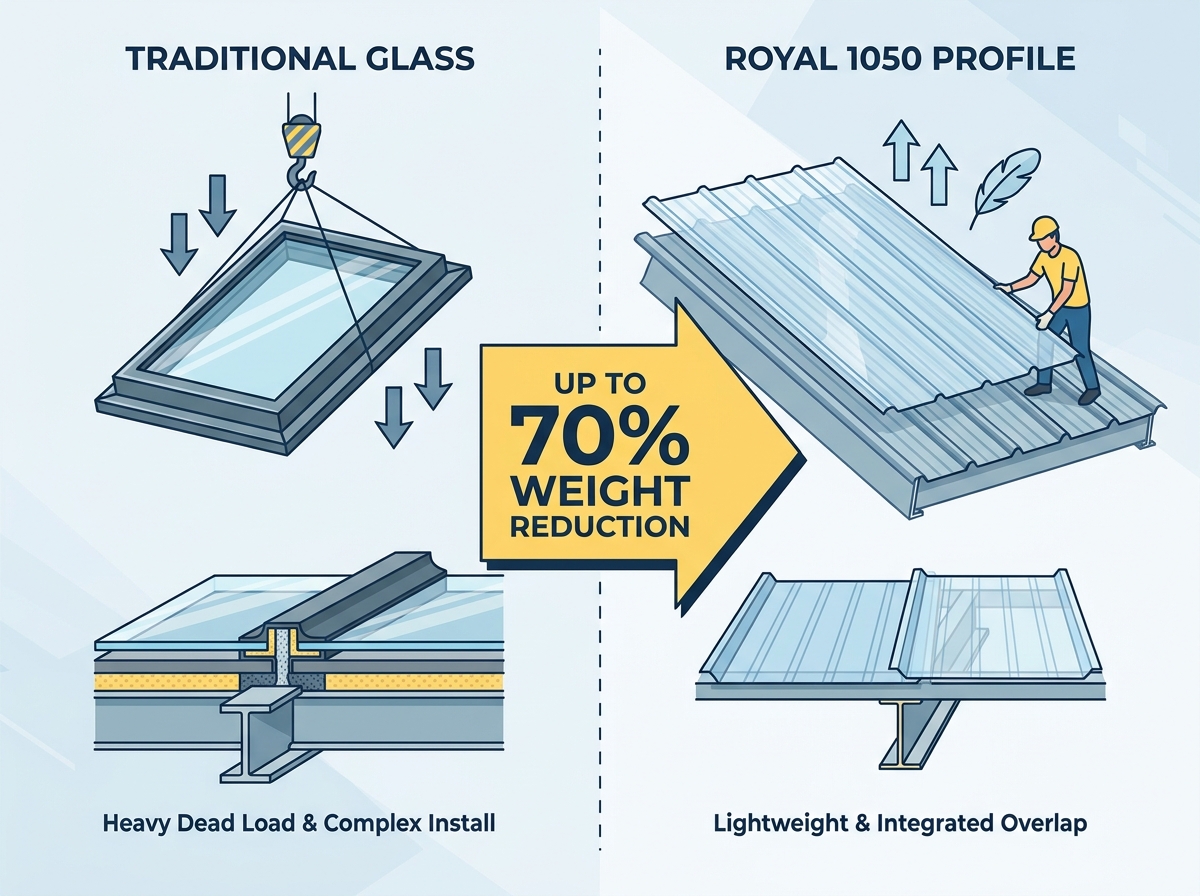
Traditional glass skylights introduce heavy dead loads into the roof structure. They demand reinforced superstructures to support their massive weight. Furthermore, heavy glass presents catastrophic shatter risks in high-traffic commercial zones. These brittle systems also demand complex, labor-intensive installation processes. Such factors create massive logistical hurdles for facility managers.
For facility managers and contractors evaluating daylighting upgrades, specialized synthetic solutions offer a better path. A high-quality translucent roof panel—specifically the Royal 1050 profile—provides a structurally optimized, cost-efficient, and safer alternative to fragile glass. In this guide, you will learn how modern profiling upgrades facility resilience, streamlines installation, and mitigates long-term maintenance headaches.
The Royal 1050 profile reduces structural dead weight by up to 70% compared to equivalent glass installations.
Advanced synthetic panels provide superior light diffusion, eliminating the harsh glare and thermal hot spots common with clear glass.
Installation times are significantly reduced due to continuous profile-matching with adjacent corrugated metal roofing.
Vetting a reliable translucent roof sheet royal 1050 manufacturer requires evaluating their UV co-extrusion technology and warranty transparency.
Upgrading a facility roof requires justifying the initial material change. Industrial facilities cannot afford prolonged downtime. Moving away from legacy glass skylights delivers immediate structural and operational advantages.
Safety remains the top priority in high-traffic commercial zones. Heavy machinery and constant vibrations stress aging roof systems. Addressing the severe liability of falling shattered glass is critical. Forklift impacts against support columns can easily crack overhead glass panes. Modern synthetic materials eliminate this catastrophic shatter risk entirely. They bend and flex under stress instead of breaking into dangerous shards.
Glass skylights demand massive steel frames. Replacing heavy glass framing lowers the required steel tonnage for roof superstructures. A lighter roof allows engineers to optimize the entire building framework. You save material costs during the initial build. You also reduce the seismic mass of the roof, improving overall building resilience during earthquakes.
Unfiltered sunlight creates intense indoor heat. Facility managers must balance the HVAC costs of thermal transfer against illumination benefits. Single-pane glass acts like a magnifying lens, trapping heat indoors. Integrating a modern warehouse skylight tile solves this dilemma. These synthetic tiles diffuse sunlight evenly. They provide ample daylight while blocking direct thermal radiation. Your cooling systems work less, saving significant energy dollars monthly.
Glass frames trap water and debris. Moving from high-maintenance glass frames to integrated, overlapping sheet profiles drastically reduces upkeep. Traditional skylights rely heavily on silicone sealants. Sun exposure degrades these sealants quickly, causing persistent leaks. Corrugated profiles nest seamlessly into the surrounding metal roof. This eliminates bulky transition frames and stops water pooling at the source.
Choosing the right daylighting material requires strict engineering criteria. We must compare the modern Royal 1050 profile against traditional glazing across several performance metrics.
The shatterproof synthetic composition vastly outperforms brittle glass. Industrial roofs endure brutal environmental strikes. A simple dropped tool can destroy a glass skylight instantly. Synthetic panels absorb kinetic energy safely. Assessing standard drop-ball impact tests proves this resilience. Engineers drop a heavy steel ball onto the panel from a specified height. Glass shatters immediately. The Royal 1050 synthetic profile merely deflects and returns to its original shape. It also boasts extreme weather deflection capabilities. Large hail bounces off the surface without causing catastrophic failure.
Visual comfort directly impacts worker productivity. A specialized natural lighting roof sheet outperforms clear glass easily. Clear glass creates harsh shadows and blinding machinery glare. Synthetics are engineered for light scattering. They scatter incoming rays, bathing the floor in soft, even light. This reduces eye strain for forklift operators and assembly line workers.
We must also address the necessity of integrated UV protective layers. Untreated glass allows destructive UV rays to penetrate the building. UV radiation degrades stored inventory and weakens indoor plastics. High-grade synthetic panels feature co-extruded UV barriers. They block up to 99% of harmful rays, preventing inventory degradation entirely.
All building materials expand and contract. We must conduct a transparent evaluation of how synthetic sheets move differently than glass. Synthetics have a higher coefficient of thermal expansion. They grow slightly on hot summer days. The Royal 1050's specific corrugated geometry accommodates this movement naturally. The overlapping corrugations flex without breaking the weather seal.
This design also prevents capillary water action. Water often creeps upward between flat glass panes. The steep angles of the Royal 1050 profile stop water ingress completely. Installers achieve a watertight seal without relying heavily on degrading silicone caulks.
The table below outlines the core differences between standard glass and the Royal 1050 synthetic profile across key architectural requirements.
| Performance Metric | Traditional Glass Skylights | Royal 1050 Synthetic Profile |
|---|---|---|
| Dead Weight Load | Extremely high (requires heavy steel frames) | Low (reduces required structural steel) |
| Impact Resistance | Poor (shatters easily upon impact) | Excellent (absorbs hail and tool drops) |
| Light Quality | Direct, harsh glare with hot spots | Soft, diffused, and evenly scattered |
| UV Protection | Minimal unless expensively coated | High (co-extruded barriers block 99% UV) |
The Royal 1050 profile dictates the physical shape of the panel. However, you must still select the underlying chemical composition. Several advanced synthetics dominate the industrial roofing market today.
Polycarbonate offers incredible impact resistance and optical clarity. Facility managers choose it for extreme weather zones. It survives massive hailstorms easily. Polycarbonate allows maximum light transmission while enduring heavy physical abuse. However, it requires robust UV co-extrusion to prevent premature yellowing.
Fiberglass reinforced plastic represents a highly durable, budget-conscious choice. We recommend analyzing the fiberglass roof sheet for high-chemical-resistance industrial applications. FRP incorporates glass fibers into a resin matrix. It resists harsh chemical vapors and agricultural fumes brilliantly. It diffuses light well, though it lacks the crystal clarity of polycarbonate.
Polyvinyl chloride performs exceptionally well in corrosive environments. Chemical plants, coastal facilities, and fertilizer depots destroy traditional metal roofs rapidly. Evaluating the daylighting pvc panel reveals a highly stable material. Saltwater mist and acidic air barely affect high-quality PVC. It remains structurally sound where glass frames rust and degrade.
Regardless of the chosen synthetic base material, the shape matters immensely. The specific dimensional profile of the Royal 1050 optimizes overlapping joints perfectly. It matches standard corrugated steel profiles. Installers simply swap a solid metal sheet for a translucent one. This continuous nesting creates an unbroken, waterproof roof plain.
| Material Type | Primary Strengths | Best Application Environments |
|---|---|---|
| Polycarbonate | Extreme impact resistance, high clarity | Hail-prone regions, heavy industrial zones |
| Fiberglass (FRP) | Budget-friendly, excellent chemical resistance | Agricultural buildings, budget-conscious retrofits |
| PVC | Superior anti-corrosion, stable in salt air | Coastal facilities, chemical processing plants |
Even the best roofing materials fail if installed incorrectly. A translucent roof panel requires specific handling. Contractors must abandon old glass-installation habits. They must adopt protocols tailored strictly to synthetic materials.
Thermal expansion remains the primary failure point in synthetic installation. When the sun hits the roof, the panels expand. Detailing the necessity of pre-drilled, oversized fastener holes is crucial. Installers must drill holes slightly larger than the screw shaft. This gap allows the panel to slide gently under the fastener head. If crews skip this step, the expanding sheet binds against the screw and buckles upward.
Proper torque control prevents immediate material damage. You must avoid creating micro-fractures during installation. Training crews against over-tightening screws on synthetic panels saves immense trouble later. A crushed corrugation invites water pooling. Use specialized fasteners featuring EPDM rubber washers. Tighten them only until the washer compresses snugly against the panel surface.
Chemical reactions between sealants and panels cause rapid degradation. Ensuring butyl tapes and mastics used at the overlaps do not chemically degrade the translucent panels is mandatory. Never use standard off-the-shelf silicone caulks unless explicitly approved by the manufacturer. Incompatible solvents melt the plastic, voiding the warranty and causing immediate leaks.
Structural support distances dictate panel survival during heavy snow or wind. Follow these structural rules strictly:
Never treat synthetic panels structurally like metal or glass. They bend more easily under load.
Calculate purlin spacing strictly according to the panel’s load-deflection charts.
Install safety netting or metal mesh beneath the panels.
Prohibit all direct foot traffic on the skylight sections during routine roof maintenance.
The market contains widely varying quality levels. Sourcing a dependable translucent roof sheet royal 1050 manufacturer requires aggressive vetting. You must look past marketing brochures and examine actual production capabilities.
Focus deeply on UV protection application methods. Checking for advanced co-extrusion lines is your first step. Co-extrusion bonds the protective UV layer directly into the base material while the plastic is molten. This prevents delamination. Avoid manufacturers relying on cheap spray-on coatings. Spray coatings flake off under heavy rain, exposing the raw plastic to immediate sun damage.
A waterproof roof requires tight physical tolerances. Exact matching to the Royal 1050 die is critical for weather-tight nesting. If the manufacturer's machinery is worn out, the corrugation angles drift. Even a slight deviation prevents the panel from locking tightly onto adjacent opaque metal sheets. Ask about their die maintenance schedules and quality control calipers.
Industrial building codes enforce strict fire safety protocols. Always prioritize structural safety over minor cost savings. Requesting verifiable ASTM fire-retardant test reports is non-negotiable. Review the smoke-spread indexes carefully. Quality manufacturers readily provide third-party laboratory testing certificates proving their panels self-extinguish or melt safely away from the flame source.
Take systematic steps before signing a bulk purchase order. Follow this targeted checklist:
Request physical samples for immediate profile verification against your existing metal roof.
Cross-reference the provided load tables against your local wind and snow requirements.
Analyze warranty exclusions thoroughly, specifically regarding the acceptable yellowing index over a ten-year span.
Confirm lead times and logistical support for job site deliveries.
Glass remains viable for high-end aesthetic architecture, but it falls short in rugged industrial environments. For functional commercial and industrial daylighting, the Royal 1050 profile wins decisively on safety, weight reduction, and overall installation efficiency. Moving away from heavy glass framing protects your workers below and reduces structural strain on your building framework.
We advise all facility managers to audit their current roof purlin spacing immediately. Identify areas where natural light could reduce ongoing HVAC and lighting costs. Next, request a spec-matched sample from a verified supplier. Begin your load calculations early to ensure a seamless, watertight integration.
A: Modern co-extruded panels behave entirely differently than outdated plastics. Advanced manufacturing bonds a dense UV-blocking layer directly into the sheet. While slight color shifts may occur over 10 to 15 years of intense exposure, high-quality manufacturing mitigates severe yellowing. Always verify the warranty terms regarding the specific yellowing index.
A: No. You must enforce strict safety protocols on the roof. Neither glass nor synthetic skylight panels should ever be walked on. They are non-traffic bearing surfaces. Facility managers must install safety mesh or rigid fall protection panels below them to ensure absolute worker safety during maintenance.
A: Single-skin synthetic sheets offer less acoustic dampening than heavy double-glazed glass. Rain noise and exterior environmental sounds will penetrate synthetic panels more easily. This makes them ideal for noisy warehouses and industrial plants, but potentially unsuitable for ultra-quiet office spaces requiring strict sound isolation.


